1. Executive Overview & Scope
Role, core UI engineering stack, and architectural ownership
As enterprise GraphQL APIs transition to support autonomous AI agents acting on behalf of users, a new design challenge emerges: how to give engineers and operators real-time visual control and governance over agentic graph traversals. I designed and engineered a production-grade prototype sandbox that visualizes non-deterministic AI agent execution against enterprise GraphQL schemas.
- Next.js (App Router), React 18, & TypeScript
- React Flow (Custom Node & Edge Rendering Engine)
- Monaco Editor & Client-Side GraphQL AST Parser
- AI Acceleration: Gemini (Architecture & Logic Synthesis) & Cursor (IDE & Implementation)
- Dynamic graph canvas for mapping agent prompt intent into executable GraphQL operation paths.
- Human-in-the-Loop (HITL) safety patterns for real-time mutation authorization and audit trails.
- Live behavioral contract inspector (JSON/YAML policy guardrails and schema validation).
2. Strategic Opportunity & Paradigm Shift
Designing for the Next API Consumer: Autonomous AI Agents
What consumes an API is fundamentally shifting. Increasingly, it is not a human clicking a UI component, but an AI agent traversing a graph to execute complex workflows. Without visual governance tools, developers cannot verify what schema branches an agent can reach or inspect real-time tool calls before dangerous mutations hit production databases.
3. AI-Driven Design Process & Build Methodology
From strategic framing to live code via Gemini and Cursor
Inspired by Apollo GraphQL's vision of powering agentic graph experiences, I moved directly from problem articulation into code using advanced AI tooling. Rather than waiting for static requirements, I leveraged Gemini to synthesize complex backend schemas into intuitive UX patterns and Cursor to pair-engineer a fully functional prototype sandbox.
Apollo Vision & Opportunity
Analyzed how GraphQL schemas serve as ideal context graphs for AI agents, identifying the core UX leverage point: visual observability and HITL governance for agent traversals.
Gemini System Architecture
Used Gemini to model interaction flows, design behavioral contract JSON schemas, and structure the state machine for multi-branch GraphQL node path execution.
Cursor Code Implementation
Paired with Cursor to write modular Next.js components, integrate React Flow custom edges, embed Monaco Editor, and build high-fidelity interactive sandboxes directly in code.
4. UI Engineering & Technical Execution
Building high-fidelity interactive systems with Next.js, React Flow, and Monaco
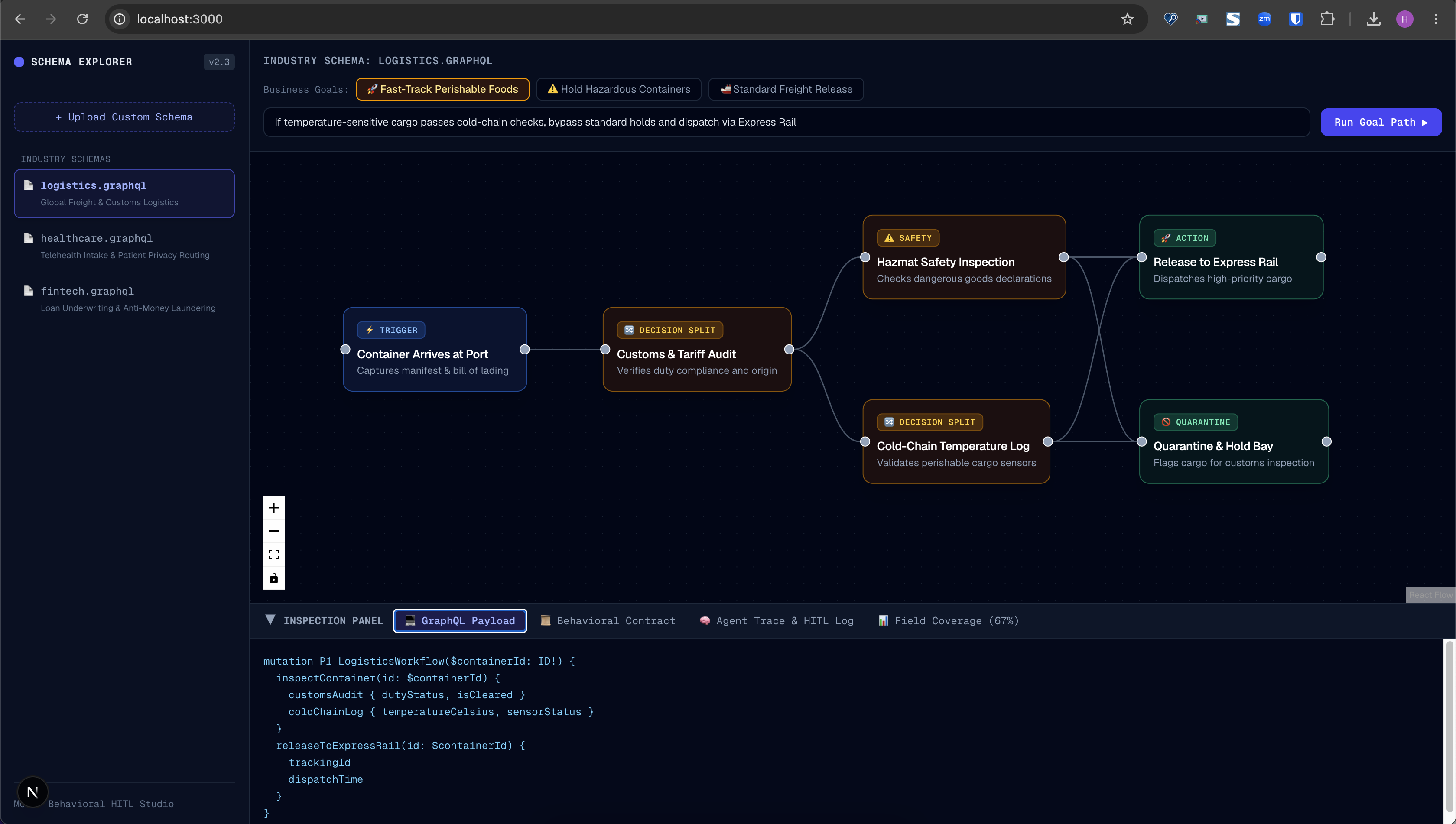
4.1 Custom React Flow Node Engine & Dynamic Path Highlighting
I extended React Flow with custom node renderers tailored to GraphQL entity relationships. When an agent processes a user prompt, the canvas dynamically highlights active execution paths with CSS glows while dimming unselected schema branches.
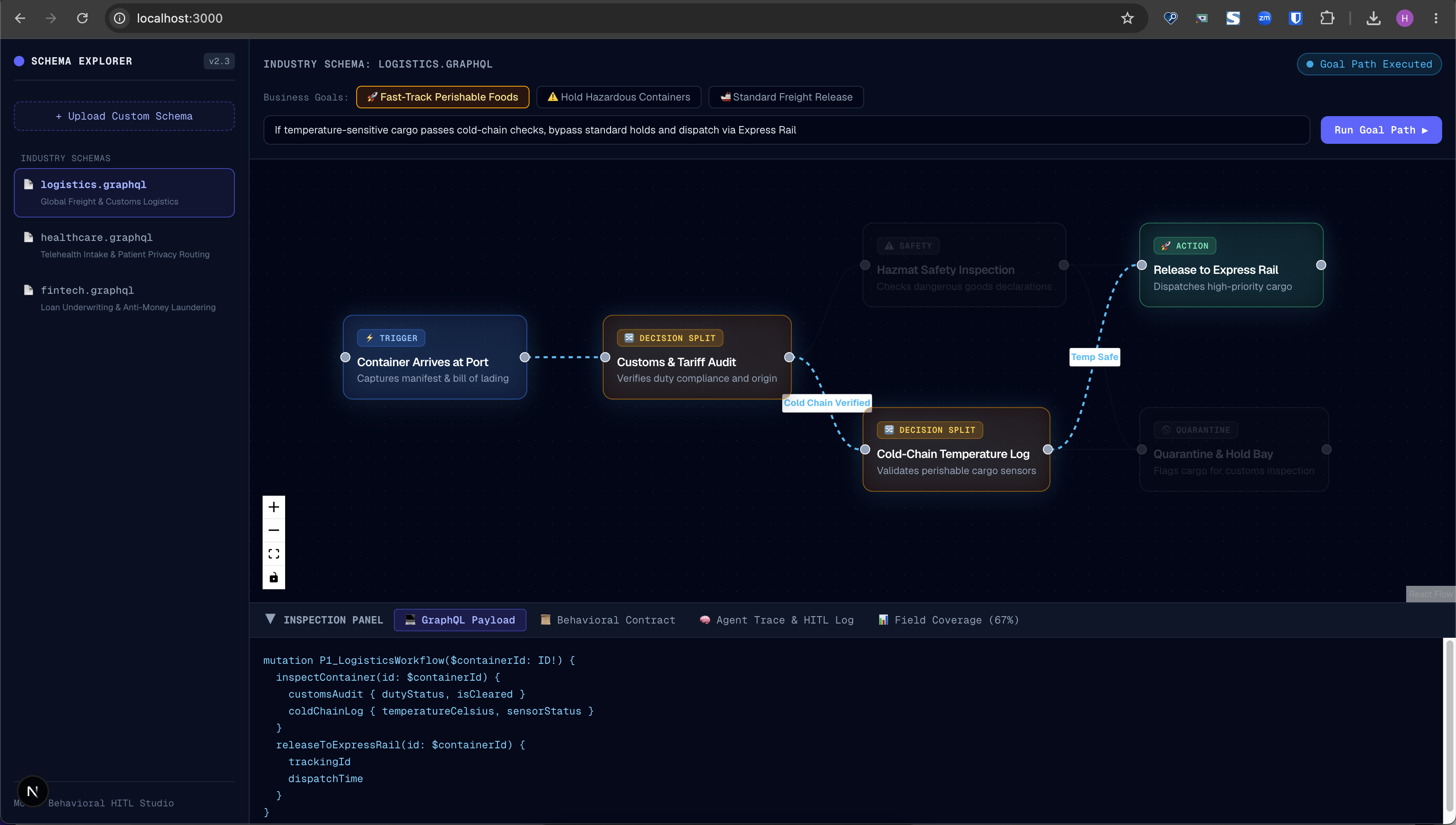
4.2 AI Behavioral Contract Inspector & JSON Guardrail Engine
I engineered an inspector drawer that displays live behavioral contracts alongside execution paths. This allows developers to inspect policy boundaries—such as max step depth, execution timeouts, and scope limits—in real-time.
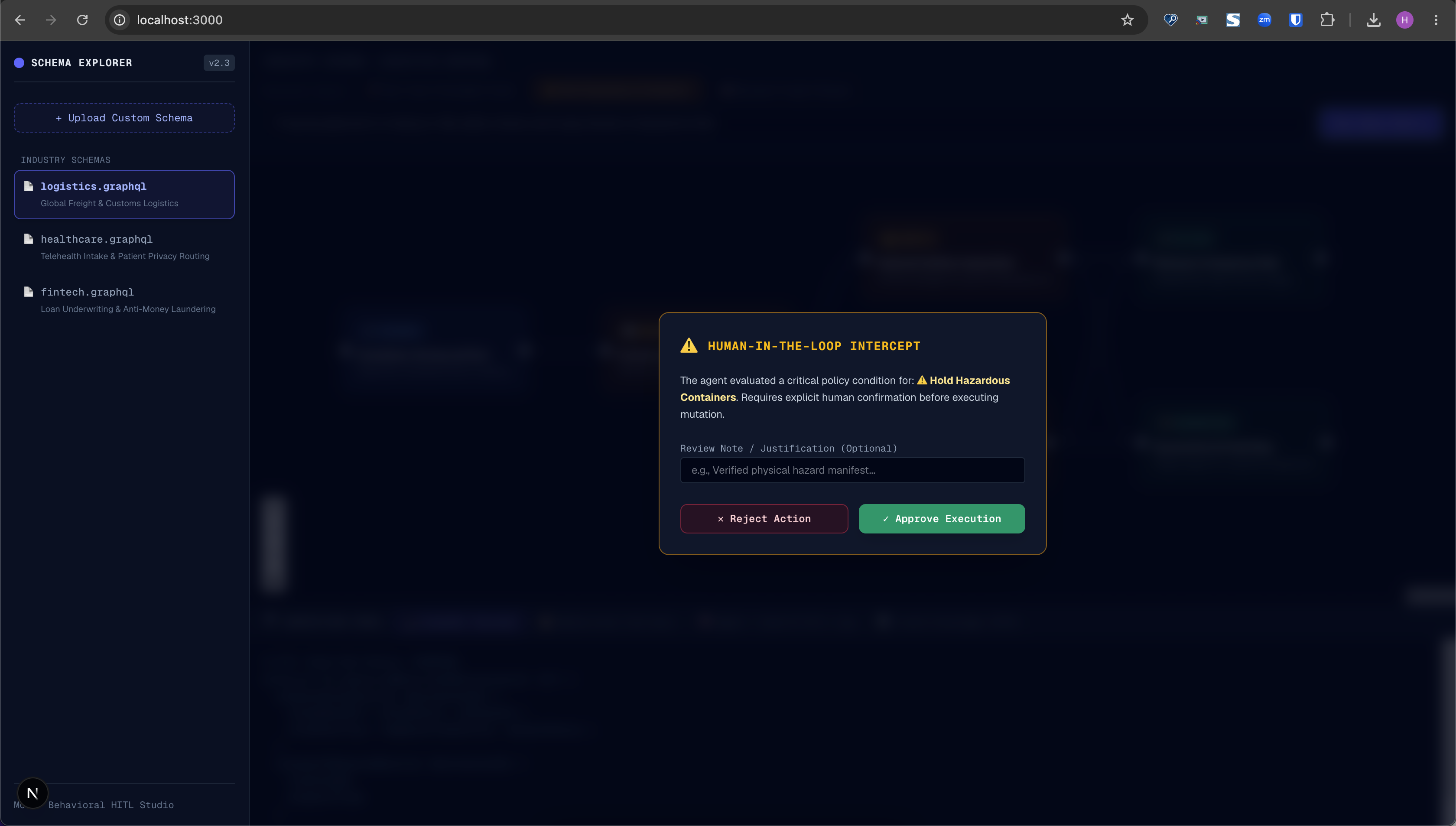
4.3 Human-in-the-Loop Intercept Modal & Audit Signature Workflow
To address developer trust and security, I designed and implemented an intercept modal. When an agent attempts high-risk GraphQL mutations, execution halts, enabling operators to inspect parameters, modify inputs, or authorize actions with audit signatures.
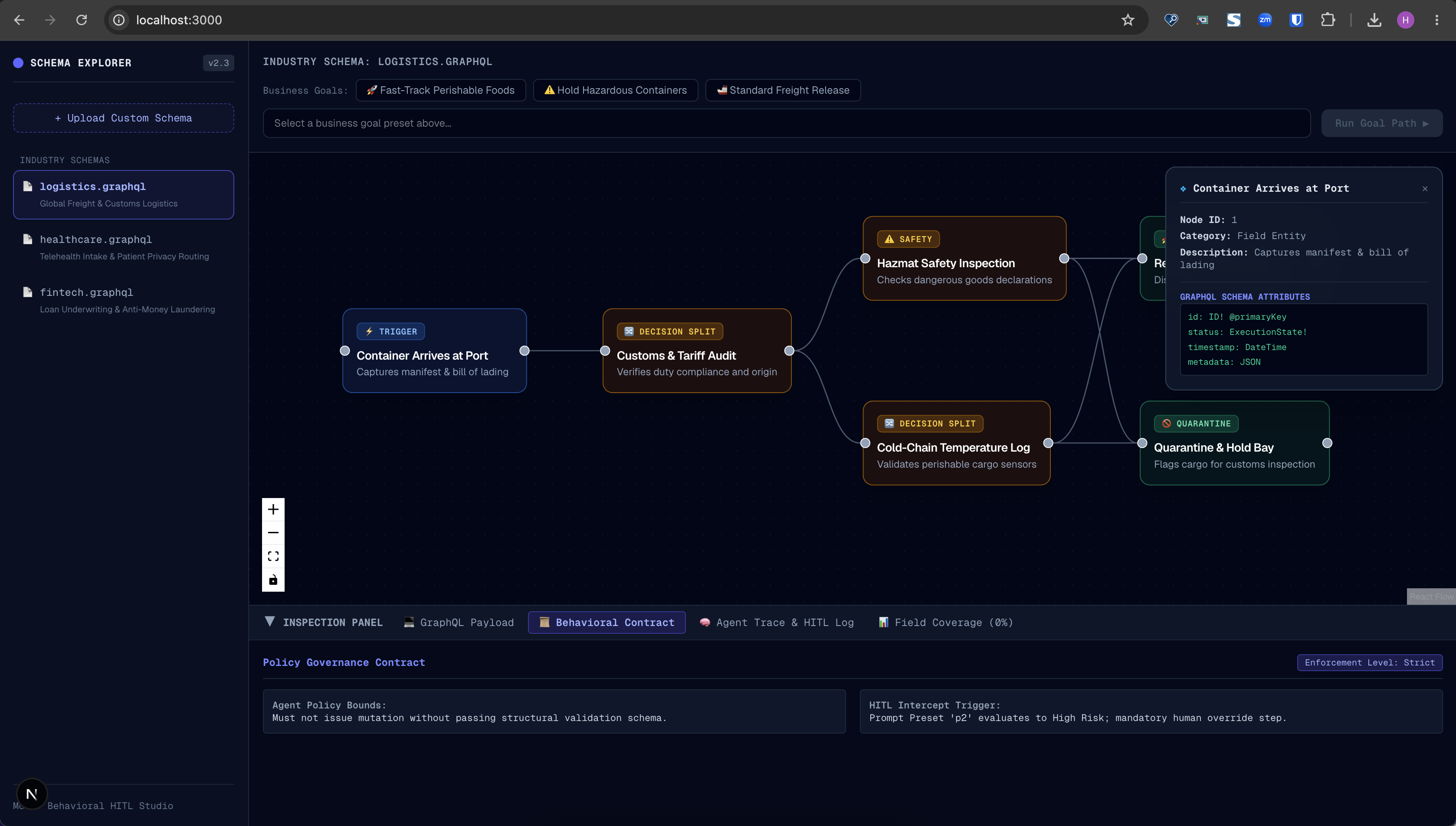
4.4 Client-Side GraphQL SDL Parser & Monaco Editor Integration
I integrated Monaco Editor into the studio alongside a client-side SDL parser. Engineers can paste raw GraphQL schema definitions to auto-generate node graphs instantly for sandbox testing.
5. Key Outcomes & Design Leverage
Proving value through proactive execution and code-level design craft
By taking full ownership from problem identification through Next.js prototype delivery, this project demonstrates how design engineering accelerates product discovery for emerging AI surfaces.
-
Proactive Problem Ownership: Transformed an ambiguous problem space (governing agentic API calls) into a tangible visual interaction model without needing upstream product specs.
-
AI Tooling Acceleration: Demonstrated how combining Gemini (for logic synthesis) and Cursor (for code implementation) compresses weeks of exploration into functional design prototypes.
-
Developer Experience Standards: Established repeatable, reusable UI components for Human-in-the-Loop governance and schema node visualizers.