1. Executive Summary & Role
Platform overview, operational context, and design engineering ownership
Hexion Intelligence OS is an enterprise AI operations platform designed for shift supervisors and mill operators in industrial lumber manufacturing. The product bridges the gap between raw IoT sensor data and autonomous industrial control by continuously streaming real-time telemetry across a 10-stage milling process—from initial log yard intake to final residual energy management.
As the product design lead, the engagement began upstream—facilitating client discovery sessions with C360 and Hexion stakeholders, identifying user trust as the primary bottleneck to AI adoption, and defining the core architectural framework across four strategic workstreams.
Driving the client discovery engagement with C360 and Hexion stakeholders, structuring key discussions around hardware form factors, environmental constraints, alert fatigue, and system autonomy.
Leveraging a modern tech stack—including React, TypeScript, Tailwind CSS, and Radix UI—custom high-density interfaces, micro-interactions, and live data simulations were coded and deployed via Vercel and GitHub. This hands-on prototyping approach proved that complex industrial telemetry could be transformed into glanceable, high-performance web applications ready for ruggedized floor environments.
2. Product Vision & Core Value Proposition
Problem space, industrial friction, and human-AI synergy
Problem Space & Industrial Friction
Modern lumber manufacturing deals with unpredictable, biological raw materials. Natural variances like sudden moisture spikes or high sap concentrations in incoming timber create severe operational friction. Without real-time visibility, these anomalies lead to heavy machinery strain, unexpected downtime, severe production bottlenecks, and lower overall recovery yields.
AI-Driven Product Solution
The platform acts as a unified industrial intelligence engine that ingests continuous 10Hz IoT sensor data across the milling lifecycle. By blending live telemetry streams with predictive machine learning models, the system actively identifies physical anomalies and translates them into actionable guidance for shift supervisors and mill operators.
Core Value & Human-AI Synergy
Hexion Intelligence OS successfully bridges the gap between fully autonomous machine control and human operational accountability. It empowers operators with data-backed recommendations—such as precision saw kerf adjustments—driving higher lumber recovery percentages, protecting high-value capital equipment from wear, and ensuring daily production quotas are met.
3. User Personas & Target Workflows
Shift supervisors, operators, and core feature capabilities
Shift Supervisor / Mill Floor Operator
The primary user responsible for managing physical throughput, monitoring machine health, and hitting shift targets (e.g., 1,200 logs/shift).
- Monitor: Continuously track macro facility health (Station Matrix) and granular telemetry (moisture, density, feed rates).
- Diagnose: Review AI-generated predictive insights (e.g., Yield Variance Forecasts).
- Action: Execute or override automated recommendations via Human-in-the-Loop (HITL) approval gates.
Key Product Features & Functional Capabilities
End-to-End Process Mapping (Station Matrix)
A 10-stage sequential tracking framework providing instant visual awareness across the entire milling lifecycle (from Log Yard to Residuals).
Predictive Intelligence & Recipe Optimization
Algorithmic forecasting that translates raw sensor data into concrete mechanical adjustments (e.g., increasing kerf clearance by 0.4mm to boost recovery by +2.8%).
Real-time Telemetry Grid
Continuous streaming of critical physical metrics, with automated conditional highlighting (amber flags) for out-of-tolerance conditions like timber moisture anomalies.
Human-in-the-Loop (HITL) Approval Engine
A safety-critical decision queue allowing operators to vet, approve, or deny high-impact AI interventions backed by transparent confidence metrics (e.g., 96.4%).
4. Key UI Design Decisions & Architectural Rationale
Designing for high-stress, high-throughput industrial control rooms
As the Lead Enterprise Product Designer & AI Design Engineer for this initiative, the design objective was to build an enterprise-grade Intelligence OS that bridges the gap between raw, high-frequency IoT data and human-in-the-loop (HITL) industrial operations. Mill floor operators and shift supervisors manage high-stress, high-throughput environments where split-second decisions prevent equipment damage and maximize lumber yield.
01 Industrial Stone Canvas & Contrast Hierarchy
Design Decision: Built directly on top of the existing Hexion design system, we established a neutral, industrial-grade canvas (#d4d4d8 Zinc 300) paired with structured structural panels (#eaeaea) to minimize eye fatigue during extended 8-to-10-hour shifts.
Rationale: Standard consumer dark modes or stark white enterprise themes fail in industrial control rooms. Adapting the existing Hexion design tokens, the zinc-toned architectural palette provides a calm, industrial aesthetic that anchors high-priority status indicators without causing glare.
02 Context-Driven Layout Architecture (Three-Column Layout)
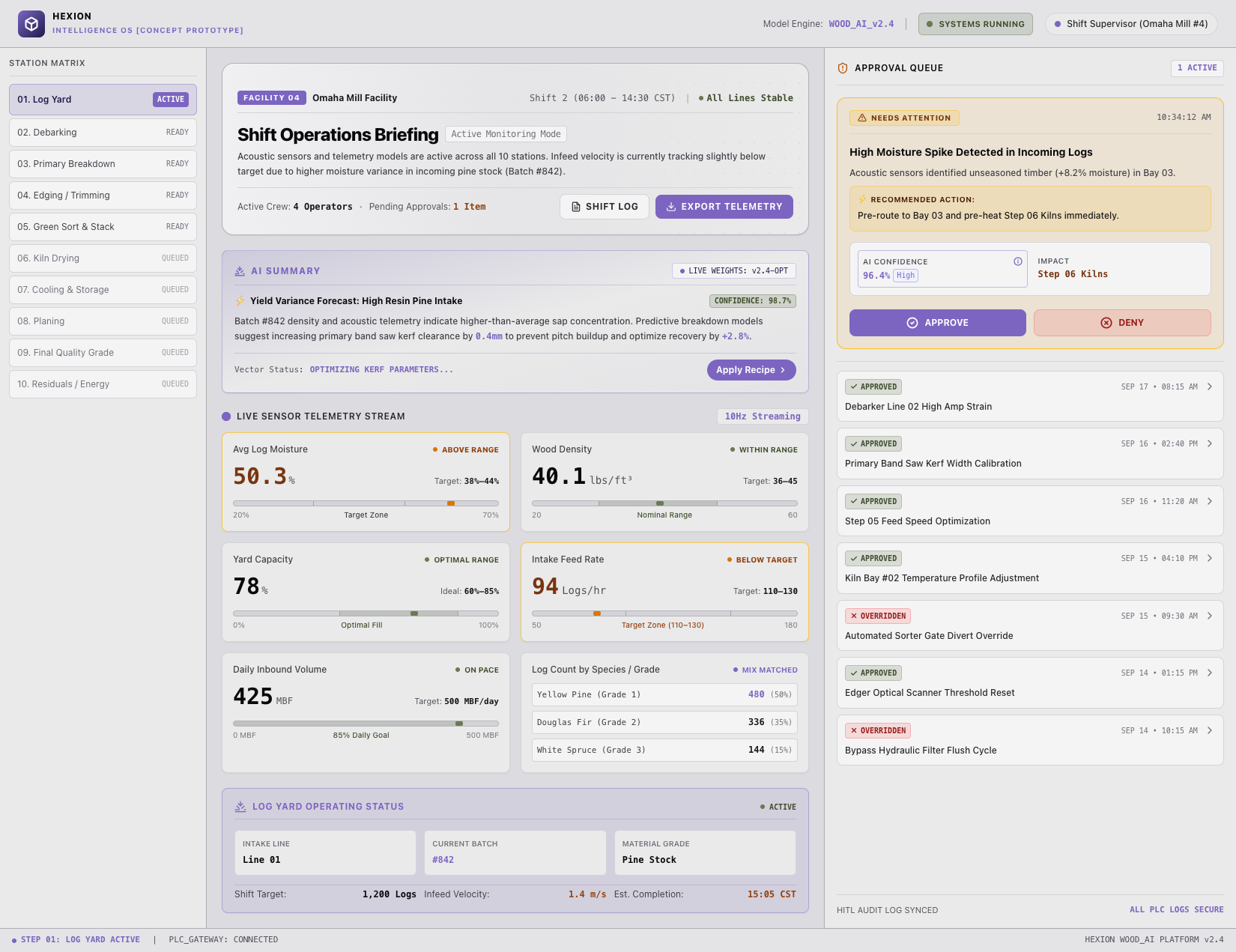
Design Decision: The interface utilizes an asymmetric 3-column layout: a left-hand Station Matrix (10-stage process map), a central operational workspace (Shift Briefings, AI Summaries, and 10Hz Sensor Streams), and a dedicated right-hand Approval Queue.
Rationale: This mirrors the mental model of a shift supervisor: macro-level spatial orientation on the left, active execution and telemetry in the center, and exception handling/gatekeeping on the right.
03 Progressive Disclosure & State-Driven Telemetry Cards
Design Decision: Sensor cards utilize conditional state formatting—neutral tones for optimal ranges (#6A7B53 accents) and prominent, high-urgency amber borders with pulsing indicator nodes for out-of-spec conditions (e.g., moisture spikes).
Rationale: In a sea of data, operators need to spot anomalies at a glance. Color-coding and animated ping indicators draw immediate visual attention to parameters that require human intervention without cluttering the dashboard.
04 Human-in-the-Loop (HITL) Safety & Transparency Patterns
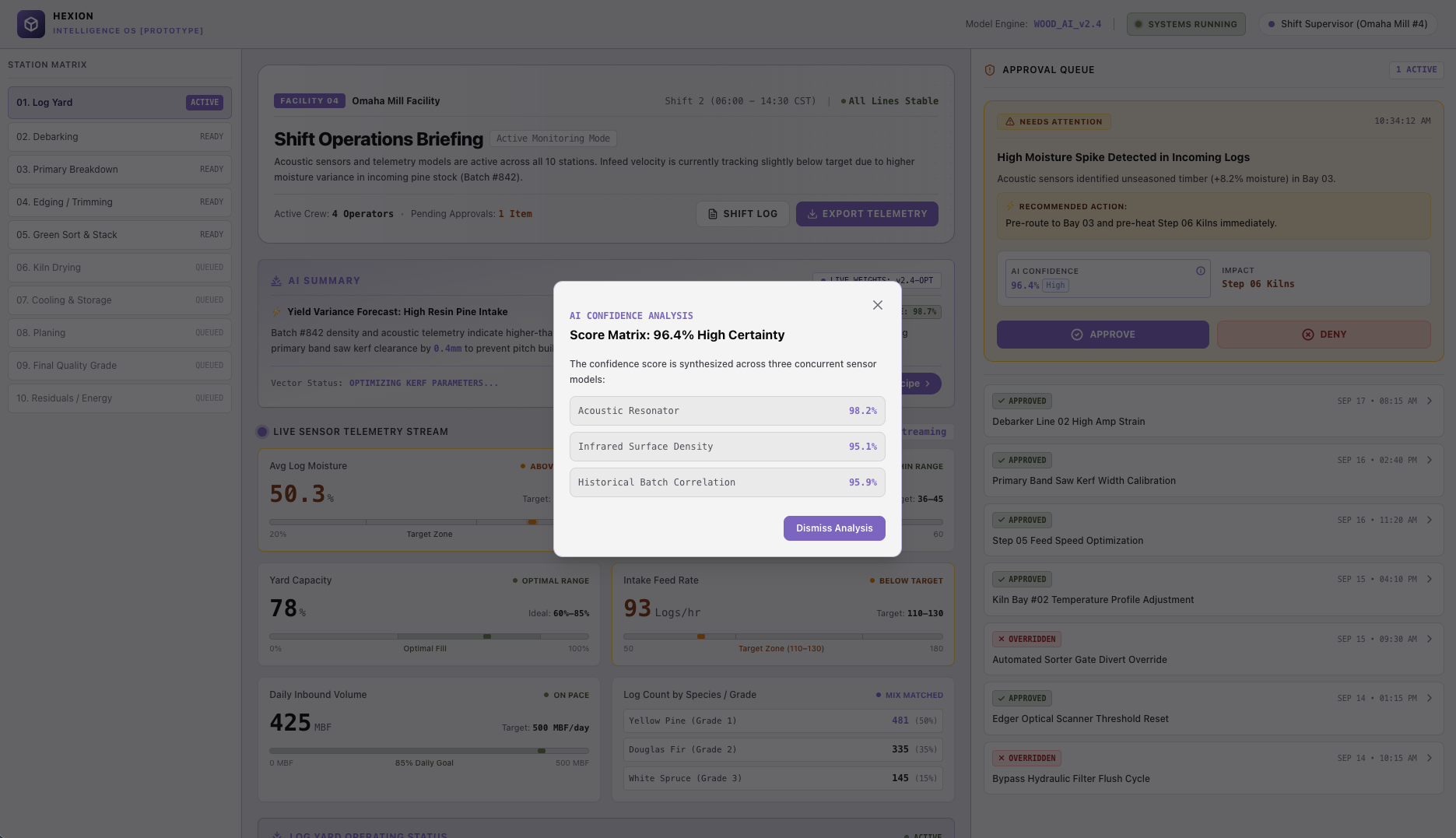
Design Decision: Critical AI recommendations are placed directly in the active approval workflow alongside explicit, clickable confidence metrics (e.g., "96.4% High") that trigger transparent modal breakdowns of underlying acoustic and infrared models.
Rationale: Industrial AI cannot operate as a black box. By surfacing multi-model confidence scores and pairing them with unmistakable action gates (APPROVE / DENY), the UI builds trust and enforces strict operational accountability.
05 Micro-Interactions & Live Data Simulation
Design Decision: Incorporated CSS-driven live data animations and pseudo-elements (@keyframes) simulating 10Hz streaming updates across metrics like log moisture and density.
Rationale: Real-time feedback reassures operators that the pipeline is actively streaming and healthy, eliminating the ambiguity of static dashboards in fast-moving manufacturing flows.
Full Platform Architecture View
Human-in-the-Loop Intercept & Confidence Breakdown
5. Quantifiable Impact & Tech Stack
Projected business results and engineering tools used
Yield & Recovery Uplift
Projected increase in lumber recovery yield by translating raw, uncalibrated sensor anomalies into precise mechanical adjustments (such as automated saw kerf clearance modifications).
Operational Efficiency & Time-to-Action
Accelerated shift response times by packaging complex 10Hz IoT telemetry and predictive AI forecasts into glanceable, 1-click approval workflows, drastically reducing the delay between anomaly detection and floor-level corrective action.
Risk Mitigation & Asset Protection
Prevented catastrophic machine jams, pitch buildup, and unexpected downtime through early anomaly detection and continuous telemetry streaming.
Alert Fatigue Reduction
Designed a tiered notification hierarchy and explainable AI (XAI) confidence scoring model that filters out low-priority noise, ensuring operators only intercept critical high-variance events.